London's Sprawl and Claygate's Green Belt
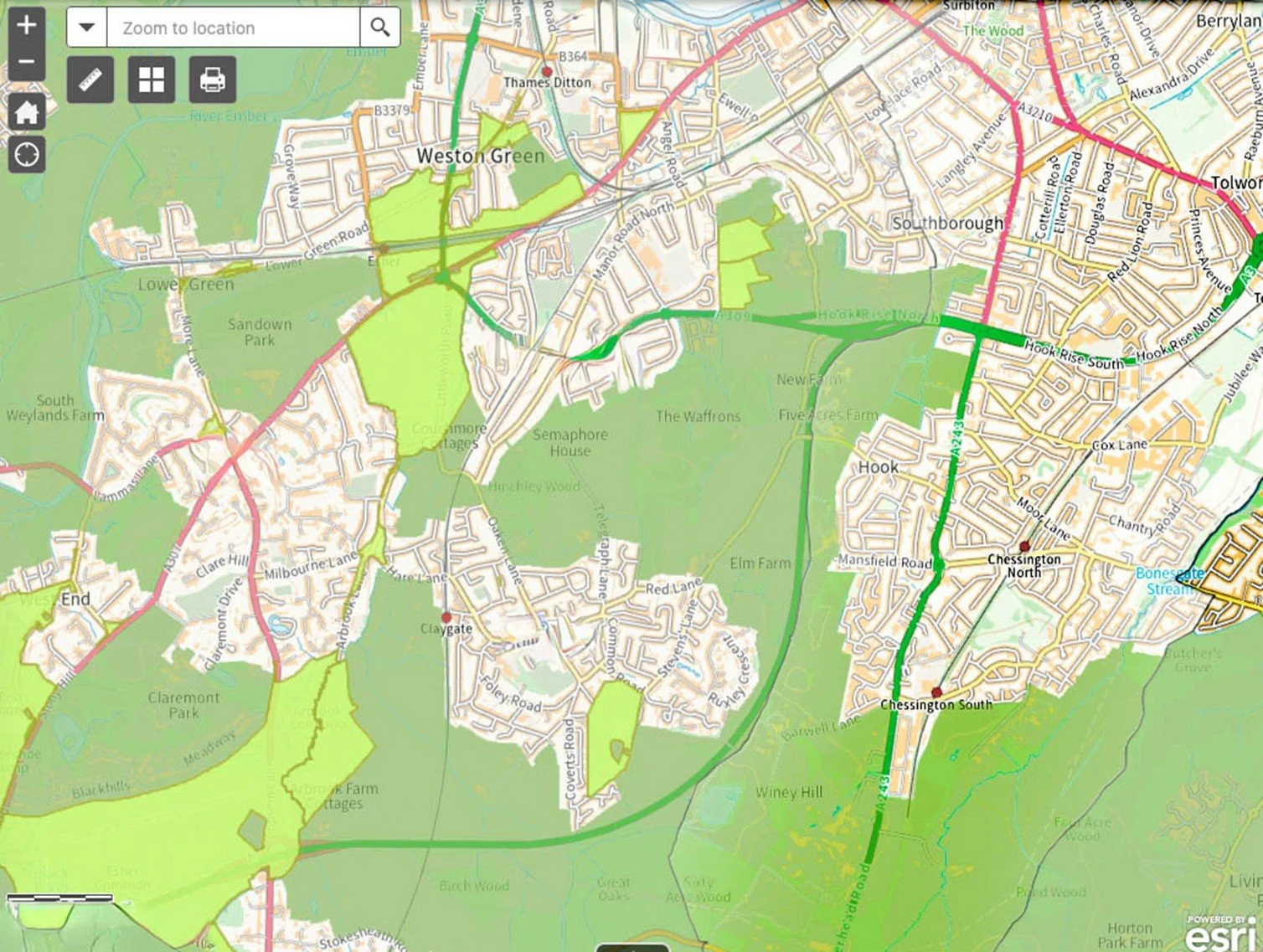
London has expanded for centuries, but especially since the 1920s. In the 1950s, planners introduced the Green Belt. One of the purposes of the Green Belt is to maintain separation between London and towns outside the sprawl.
Claygate is a village that sits on the part of the Green Belt separating the town of Esher from London.
To Claygate’s north, Hinchley Wood and Thames Ditton have long been joined up with London’s continuous urban area. To our east, Hook and Chessington are also part of the same built-up area that stretches without break to the core of London.
If development were unrestricted, London’s urbanisation would continue to push further southwest from Hinchley Wood to Esher. Claygate and its Green Belt acts as a kind of breakwater preventing this from happening.
THE ROLE OF CLAYGATE’S GREEN BELT
Let’s look at this more closely. Esher’s northeast flank is protected by common land (Littleworth Common and Weston Green) which requires all kinds of burdensome consents if you want to change it. So the pressure for London’s expansion would take the sprawl south from Hinchley Wood in line with the A3, through Claygate and our Green Belt, and on to Esher.
Any development of the Green Belt surrounding Claygate would reduce the undeveloped buffer between London and Esher. And while we don’t expect all our Green Belt areas to be developed simultaneously in one huge mega-project, they are like dominos – the first one to succumb to the developers’ ambitions will make all the rest more likely to go too.
OUR GREEN BELT – LIKE MOST THINGS ABOUT CLAYGATE – IS THE BEST QUALITY!
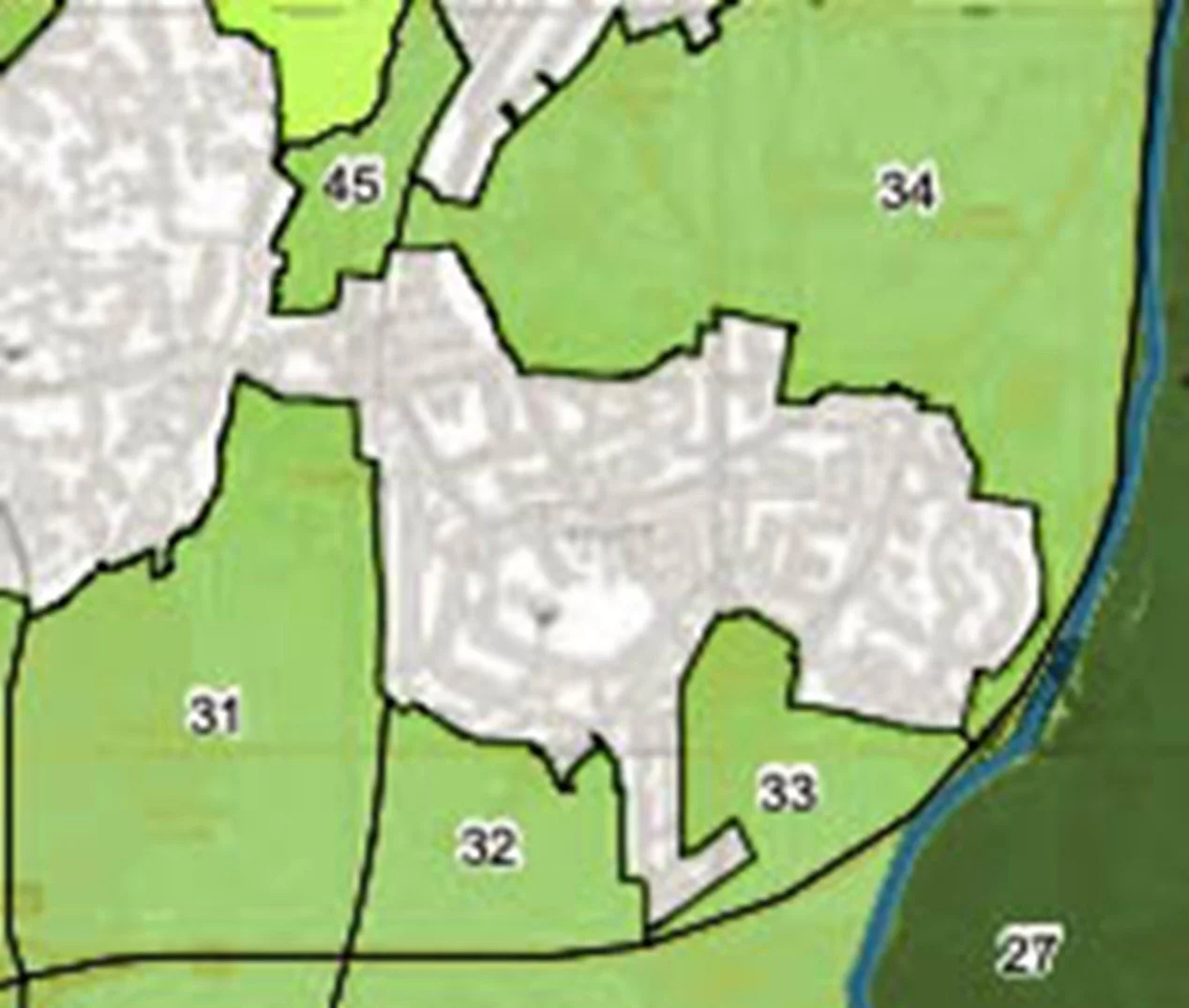
The last Green Belt Boundary Review of Elmbridge was conducted for EBC in 2016 by Ove Arup & Partners. It identified 80 separate areas for assessment, of which the ones directly surrounding Claygate were nos 31, 32, 33, 34 and 45 (see map).
Of the 80 areas, 36 areas (totalling 3,181 hectares or 7,860 acres) – including all 5 areas around Claygate – were rated as “strong” Green Belt, meaning that they strongly supported the overall purposes of the Green Belt.
Edit Image
By contrast, 31 areas (3,006 ha) were judged only to be moderate Green Belt, and 13 areas (286 ha) were judged to be weak.
Additionally, our Green Belt is strategically significant – areas 34 and 45 contribute “very strongly” to a line of Green Belt that runs all the way from the northern reaches of the Thames River and Lower Mole River floodplains, while areas 31, 32 and 33 contribute “strongly” to another line of Green Belt that runs from Runnymede, Spelthorne and Hillingdon through Claygate and on to Kingston.
QUESTIONS FOR LANDOWNERS, DEVELOPERS AND POLITICIANS
A few questions we should ask:
- The Elmbridge local plan that was rejected by the inspector assumed that 5,398 new dwellings could be built without touching the Green Belt. Are there ways to use this land, or other already occupied land, more efficiently?
- The weak Green Belt in Elmbridge is enough on its own to support 11,452 new dwellings (at the 40 /ha minimum set by the government). If we keep EBC’s assumption on the number of new houses on brownfield sites, that means that the weak Green Belt alone is nearly twice as much land as needed to make the shortfall in Elmbridge’s new housing quota for 5 years. So why on earth would we want to develop the very strongest Green Belt, such as surrounds Claygate?
- In the absence of a local plan setting out which land is chosen for development, shouldn’t decision-makers default to the next best thing – ie, choosing the weakest Green Belt to make up any shortfall of non-Green Belt land?
- Losing our Green Belt will mean the difference between Claygate being “a village with its own unique character” and “just another outer London suburb”. What evidence is there that this is what Claygate people want? (Spoiler alert: none). Or don’t Claygate people’s views matter?
- A key reason for the government’s aggressiveness in opening up land for development is to provide affordable homes. In what sense will new homes attached to Claygate, even sold at a 20% discount, be “affordable”?
- And while we understand the need for more housing, might not the benefits of building be substantially outweighed by the adverse effects of unnecessarily choosing and concreting over strong Green Belt?
